The ForgeOps Doctrine
Universal systems control is not a feature. It is a discipline for keeping command, state, and execution aligned across every approved surface. This is how Greyforge built that doctrine and why it changed the operating model.
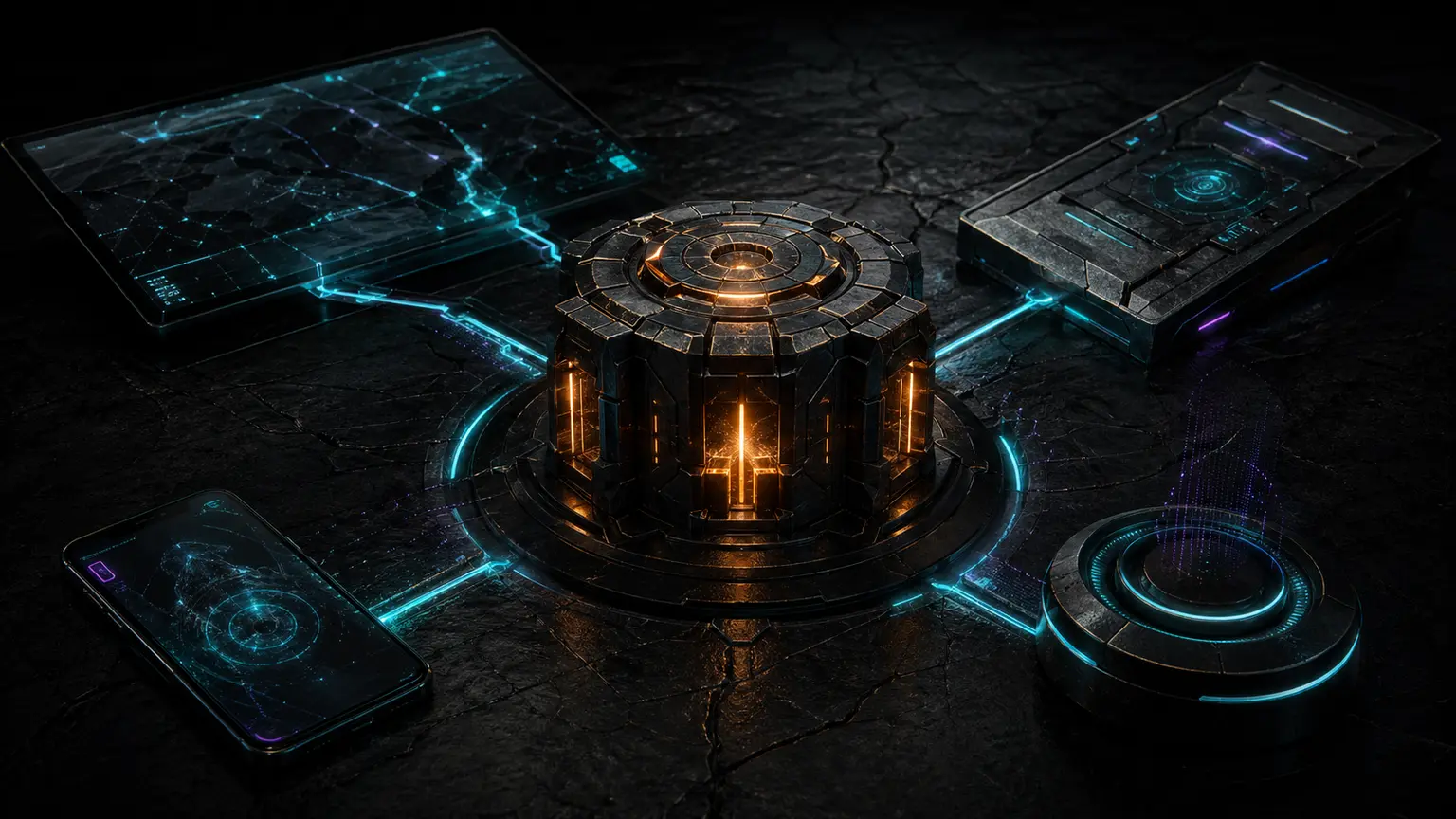
The interface layer: every surface connects to one kernel.
>_The Core Thesis
The system should remain reachable when the human is away from the desk. Not approximately reachable. Not reachable with caveats. The same agents, the same state, and the same dispatch authority should converge through approved interfaces.
That is the ForgeOps Doctrine in one sentence: decouple command from location. Everything else in this chronicle is the implementation detail that makes it real.
The doctrine emerged from a practical frustration. Greyforge had a multi-agent system and a routing layer that could send work to the right specialist, but the control surface still depended too much on local presence. The agents were capable. The infrastructure was there. The bottleneck was physical proximity.
The Interface Stack
The architectural response was not to build a mobile app. It was to build a convergent interface layer: multiple surfaces, all connecting to the same ForgeClaw kernel. The kernel does not care which surface sent the request. It classifies, routes, and executes identically regardless of origin. The interface only shapes presentation.
Mobile Command Surface
A portable command interface for agent dispatch, task queuing, communication work, and system health checks through an authenticated messaging surface.
Desktop Surface
A desktop command surface for chat, status monitoring, controlled execution, and live feedback through the same control plane.
Terminal Surface
A keyboard-first surface for remote sessions, provider health, routing state, and agent activity without leaving the shell.
CLI
Scripted automation and direct agent invocation. The command line is the programmatic entry point into the agent fabric.
Multiple surfaces. One control plane. A mobile interface and a terminal produce consistent behavior because they converge through the same governed execution path. The interface is a window. The control plane is the system.
The Networking Foundation
Location agnosticism requires predictable reachability beneath the interfaces. The Vault Lattice provides a private fabric with consistent local and remote control paths.
The foundation is a persistent path between coordinated nodes. It removes most of the ambiguity that makes multi-node operations fragile.
Above that sits a secure remote access layer so the same fabric remains reachable away from the desk. The exact routing mechanics are private. The public point is that local and remote control converge on the same system instead of creating two contradictory paths.
The result is continuous reachability: node-to-node, human-to-fabric, and interface-to-control-plane, without treating remote control as a second-class mode.
The Agent Layer
Seven specialist agents form the Council. Each has a defined domain, its own workspace, identity definition, and behavioral constraints. The coordination layer is anchored to a persistent node, which means the agent fabric remains available whether the primary workstation is awake or not.
What ForgeOps adds to the Council architecture is interface-agnostic dispatch. The same agent invocation can move through approved mobile, desktop, terminal, or scripted surfaces while retaining the same authority and context boundaries.
Dispatch From Anywhere
All paths resolve through the same governed routing and execution path.
Agent state persists across interfaces. A session can move between approved surfaces without losing context because the interaction is tied to the agent and task, not to a single window.
Headless Operations
One part of the fabric behaves as a persistent operations anchor rather than an attended workstation. It stays available without needing a local user at the keyboard and carries the coordination surfaces that keep the doctrine alive when the primary desk is elsewhere.
Making this reliable required explicit control over power and availability policies. Consumer defaults optimize for convenience and battery behavior. ForgeOps needed the opposite: predictable persistence and fast recovery.
Critical services start without interactive ceremony, recover on failure, and return after interruptions. The important public fact is not the unit names. It is that the control plane does not depend on a manual login ritual to exist.
The consequence: the agent fabric survives individual node restarts. One surface can reboot, update, or temporarily disappear while the coordination layer keeps essential work reachable. The system degrades gracefully instead of failing completely.
The Gateway Protocol
Every interface connects through an authenticated gateway. The handshake is explicit. Authority is scoped. Requests do not arrive through ambient trust.
Dispatches are acknowledged, tracked, and streamed back to the calling surface. That allows different interfaces to present the same underlying run in whatever form makes sense for that medium.
That contract is what makes convergence real. The kernel does not need a separate logic stack for each surface.
>_The Principles
ForgeOps is not a product. It is a set of constraints that, when enforced together, produce location-agnostic operations. These are the principles as they exist in the running system, not as aspirations.
Operational Doctrine
- Every interface connects to one kernel. No separate backends, no divergent state. The kernel is the single point of classification, routing, and execution.
- Agent state persists across interfaces. A session started on one surface is continuable on another. The agent remembers the context, not the window.
- Capability boundaries are documented and agent-readable. Agents consult current capability records before acting.
- The fabric survives individual node restarts. Persistent coordination keeps the agent layer available through ordinary interruptions.
- The harness determines reliability, not the model. Provider health tracking, fallback paths, and degraded-state routing are built into the executor. The system adapts to provider failures without manual intervention.
Voice as a Fifth Interface
The VoiceOps pipeline extended the doctrine to spoken interaction. Authorized voice input can reach the same command fabric without switching to hands-on input.
Voice does not replace the other interfaces. It layers on top of them. The same gateway discipline, routing boundary, and agent council remain in force. Voice simply adds an approved surface for moments when hands-on input or a screen is not available.
>_What Changed Because of This
Before ForgeOps, stepping away from the workstation meant stepping away from the system. Agents were available but unreachable. Infrastructure was running but harder to manage. The work was tethered to the interface.
After: implementation, audit, and health-check work can move through the approved surface that fits the moment. The work does not stop because the human moved.
The deeper shift is operational confidence. When you know the fabric remains available, the control plane stays reachable, and the agents remain callable, you stop thinking about infrastructure access and start thinking about what to build next. That is the real output of the doctrine. Not remote access as a feature. Remote access as a precondition so invisible it stops being a consideration.
>_What Comes Next
The doctrine is implemented. The immediate frontier is depth, not breadth. The coordination layer is being hardened further, telemetry is becoming more durable, and the v3 kernel rebuild is tightening the contract between interfaces and the execution layer so new surfaces can be added without rewriting the core.
The thesis does not change. Command decoupled from location. Every interface into one kernel. The fabric survives any single point of failure. Everything else is implementation.